Cryptocurrency has evolved from an investment-focused technology into an increasingly relevant component of modern financial infrastructure. Businesses can now use digital assets for payments, transfers, settlement, treasury management, and cross-border transactions. The scale is no longer marginal: McKinsey and Artemis Analytics estimate actual stablecoin payments reached roughly $390 billion in 2025, with business-to-business transactions accounting for $226 billion of that total, and the stablecoin market overall has grown past $300 billion in circulating supply.
For fintechs, payment platforms, money service businesses (MSBs), wallet providers, and global companies, understanding the different crypto payment methods is becoming increasingly important. The challenge, however, is not simply accepting cryptocurrency. Businesses also need reliable infrastructure for wallets, transaction monitoring, conversion, settlement, compliance, and connections to traditional banking rails.
This is where companies such as PRETpayments are relevant. PRETpayments provides infrastructure for approved fintechs, MSBs, wallet platforms, stablecoin companies, and other financial businesses that need banking, payment, settlement, compliance, and digital-asset capabilities connected through an orchestration layer.
In this guide, we explore how crypto payments work, the most common payment methods, what they cost, how Bitcoin payments are made, and what businesses should consider when adding crypto to their payment infrastructure.

What Are Crypto Payment Methods?
Crypto payment methods are the different ways businesses and individuals can send, receive, or settle payments using cryptocurrencies or blockchain-based digital assets.
These methods can include:
- Direct cryptocurrency transfers
- Stablecoin payments
- Crypto payment gateways
- Wallet-to-wallet transfers
- QR-code payments
- Blockchain-based payment links
- Stablecoin-linked debit and credit cards
- Cryptocurrency-to-fiat conversion
- API-based crypto payment integrations
The appropriate method depends on the business model and the type of customer being served. For example, an online merchant may want a simple checkout experience, while a fintech may need programmable payment infrastructure that can automatically receive, convert, reconcile, and settle transactions.
This distinction is important because crypto payments are not simply a replacement for cards or bank transfers. They introduce a different infrastructure layer involving blockchain networks, wallets, digital assets, private-key management, transaction confirmation, liquidity, and potentially conversion between crypto and fiat currencies.
Why Are Businesses Using Crypto for Payments?
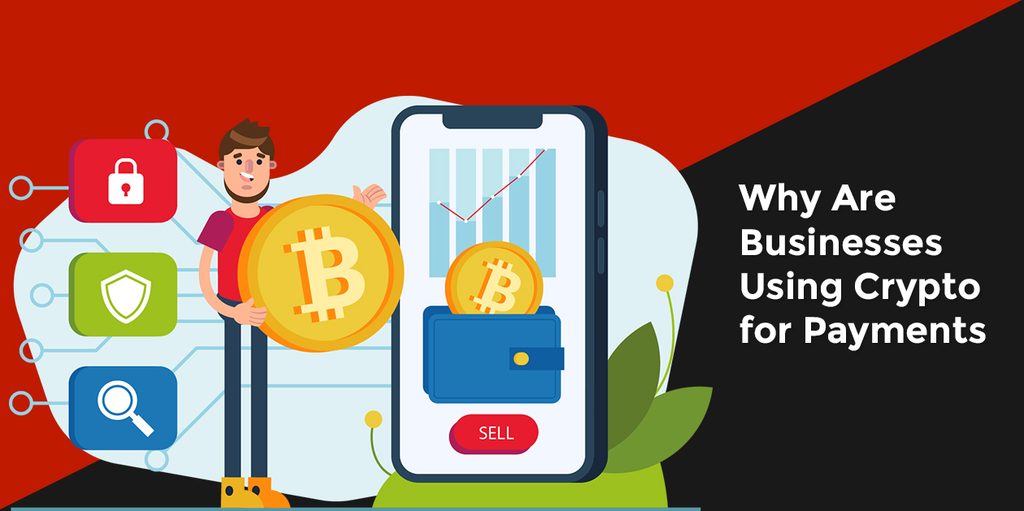
One of the main attractions of crypto payments is the ability to transfer value using blockchain networks without relying exclusively on traditional payment rails.
Bitcoin, for example, allows users to send and receive funds directly using a wallet. Bitcoin.org explains that users can make payments by entering a recipient’s address and amount or by scanning a QR code.
For businesses, potential advantages can include:
Global reach:
Blockchain networks operate across borders, which can make digital assets relevant to international payment flows.
Programmability:
Businesses can integrate blockchain transactions into software and automated financial workflows.
Alternative settlement rails:
Digital assets can complement traditional bank transfers and payment networks. Merchant-facing gateway fees for crypto typically run in the 0.4–1.5% range, compared with roughly 2–3% for traditional card processing, though businesses still need to weigh network fees and conversion costs against that headline number.
24/7 availability:
Blockchain networks do not follow traditional banking hours, although businesses still need to consider the availability of their banking, exchange, liquidity, and settlement partners.
Stablecoin-based payments:
Stablecoins can provide a digital-asset payment mechanism designed to maintain a relatively stable value against a reference currency, commonly the U.S. dollar.
However, crypto payments also introduce risks and operational requirements. Businesses need to consider asset volatility, network fees, blockchain selection, custody, fraud, sanctions screening, transaction monitoring, liquidity, accounting, tax treatment, and applicable regulations.
What Is a Bitcoin Payment Method?
A bitcoin payment method allows a customer to pay a business or another person using Bitcoin.
A typical payment flow is straightforward:
- The recipient creates or provides a Bitcoin payment address.
- The payer enters the address and amount into a Bitcoin wallet.
- The payer reviews and authorizes the transaction.
- The transaction is broadcast to the Bitcoin network.
- The recipient’s system detects the transaction.
- The recipient waits for the appropriate confirmation or settlement policy before treating the payment as final.
Bitcoin’s developer documentation describes payment processing as involving the creation of a payment request, communicating the destination and amount to the spender, and detecting the resulting transaction.
Businesses can make this process easier through QR codes or payment links, reducing the possibility of customers manually entering long wallet addresses.
How to Pay Someone in Bitcoin?

If you’re wondering how to pay someone in bitcoins, the basic process is:
- Have a Bitcoin wallet. The sender needs a wallet capable of holding and sending Bitcoin.
- Obtain the recipient’s payment address. The recipient can provide a Bitcoin address or compatible payment request.
- Enter or scan the payment details. Many wallets allow users to scan a QR code rather than manually typing the destination address.
- Enter the amount. The sender enters the amount of Bitcoin to send. Depending on the wallet and payment request, the amount may already be specified.
- Check the details carefully. Blockchain transactions can be difficult or impossible to reverse once confirmed. The sender should verify the destination and amount before authorizing the payment.
- Confirm the transaction. The sender authorizes the transaction through their wallet.
- Wait for confirmation. The recipient can monitor the blockchain for the transaction and apply an appropriate confirmation policy before considering the payment complete.
Bitcoin.org similarly describes payments as being made through a wallet by entering the recipient’s address and payment amount, with QR codes available for easier address entry.
For businesses, the process becomes more sophisticated because every payment may need to be associated with a customer, invoice, order, or internal ledger record. In practice, this association is usually handled by the payment gateway rather than manually: most gateways generate a unique, one-time payment address (or a unique payment amount down to the fractional unit) for each invoice or order, then watch the blockchain for a matching transaction and fire a webhook back to the merchant’s system once it clears. That webhook is what triggers the order-fulfillment or ledger-update step automatically, so the business doesn’t need to manually match incoming transactions to customers.
What Is a Crypto Payment Gateway?
A crypto payment gateway is infrastructure that allows a business to accept digital-asset payments from customers. Instead of building blockchain payment functionality from scratch, the business can use a gateway to manage parts of the payment workflow.
Depending on the provider, functionality can include:
- Payment address generation
- Wallet connectivity
- Transaction monitoring
- Payment-status notifications
- Exchange-rate calculations
- Crypto-to-fiat conversion
- Settlement
- Reconciliation
- Reporting
This can make crypto payments more accessible to merchants and platforms that do not want to operate blockchain infrastructure directly.
Several named providers dominate this space, and their pricing and custody models vary meaningfully:
| Gateway | Typical fee | Custody model | Notable feature |
| BitPay | 1–2% + a small fixed fee per invoice | Custodial | Broad merchant directory, fiat settlement |
| NOWPayments | 0.5–1% | Semi-custodial | 200+ cryptocurrencies supported |
| CoinGate | ~1% | Custodial | Strong in European markets |
| Coinbase Commerce | ~1% | Non-custodial | Trusted brand, hosted checkout |
| Blockonomics | 1% (first 10 transactions free) | Non-custodial | Funds go directly to merchant wallet |
| CryptoProcessing / B2BinPay | Negotiated, typically sub-1% | Custodial or hybrid | Built for high-volume B2B flows |
For example, modern payment platforms can provide APIs that allow businesses to integrate stablecoin payments into checkout and other workflows. Stripe’s current documentation describes stablecoin payment acceptance through its payment APIs and checkout products, with eligible businesses receiving settlement in USD.
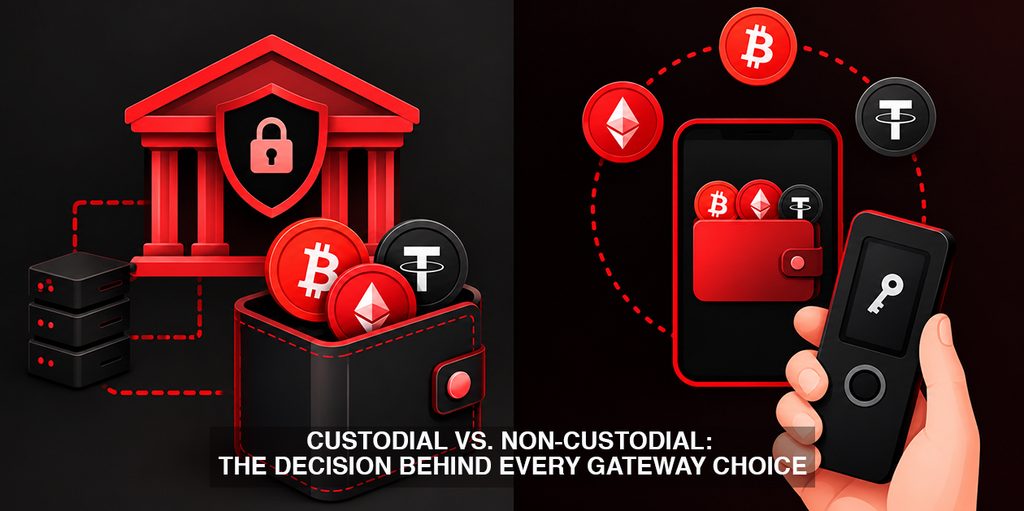
Custodial vs. Non-Custodial: The Decision Behind Every Gateway Choice
Before comparing fees or features, businesses evaluating a crypto payment gateway need to settle a more fundamental question: who holds the funds between the moment a customer pays and the moment the business can use the money?
Custodial gateways (BitPay and CoinGate are common examples) take control of the funds on the business’s behalf, often converting them to fiat automatically and settling to a bank account. This removes the need to manage private keys or blockchain infrastructure directly, but it means trusting the provider’s solvency and security, and it typically comes with more KYC/KYB requirements before onboarding.
Non-custodial gateways (Blockonomics and BTCPay Server are common examples) route payments directly to a wallet the business controls. The business keeps full control of the funds and private keys at all times, which reduces counterparty risk, but it also means the business is fully responsible for wallet security, key management, and its own conversion to fiat if needed.
Some providers, like NOWPayments, operate a hybrid or semi-custodial model, briefly holding funds during conversion before passing them on. There’s no universally “better” option the right model depends on the business’s risk tolerance, technical capacity to manage keys securely, and whether it needs automatic fiat conversion or wants to hold crypto directly.
How Does a Crypto Payments API Work?
A crypto payments API allows software applications to communicate with crypto payment infrastructure programmatically.
For a business, this could mean creating payment requests, receiving transaction notifications, checking payment status, managing wallet-related workflows, or initiating transfers through software.
A simplified architecture could look like:
Customer → Business application → API → Crypto/payment infrastructure → Blockchain → Payment confirmation
APIs become particularly useful when crypto payments need to be integrated into an existing financial platform rather than offered as a standalone payment option.
For example, a fintech may want to:
- Create a payment request automatically
- Assign a transaction to a customer
- Monitor blockchain activity
- Update an internal ledger
- Convert digital assets into fiat
- Trigger settlement
- Generate transaction reports
Bitcoin’s developer documentation notes that payment processing steps can be outsourced through third-party APIs and services, illustrating how API infrastructure can abstract some of the technical complexity of blockchain payments.
Which Blockchain Networks Matter for Payments?
Not all blockchain networks are built for the same job, and the network a business chooses affects transaction cost, speed, and available liquidity:
Bitcoin remains the most widely recognized network for direct crypto payments, though on-chain transaction times and fees can vary with network congestion. The Lightning Network, a layer built on top of Bitcoin, enables near-instant, low-cost microtransactions for use cases where speed matters more than on-chain settlement.
Ethereum is the most established network for stablecoin payments (particularly USDC and DAI) and offers deep liquidity, though gas fees can be higher than newer networks.
Tron is widely used for USDT transfers specifically because of its low fees, making it a common choice for high-volume, lower-value stablecoin payments in emerging markets.
Solana offers sub-second settlement and very low fees, which has made it popular for both stablecoin payments and newer agentic and machine-to-machine payment infrastructure.
Base, Polygon, and Arbitrum are Ethereum layer-2 networks that offer much lower fees than Ethereum’s base layer while retaining compatibility with its tooling and liquidity, making them common choices for merchant-facing stablecoin payments.
Businesses evaluating crypto payments should choose a network (or support multiple networks) based on their customers’ preferences, typical transaction size, and the trade-off between speed, cost, and liquidity depth.
Crypto Payments and Stablecoins
While Bitcoin is one of the best-known cryptocurrencies, stablecoins have become particularly relevant to payment infrastructure. Stablecoins are digital assets designed to maintain a relatively stable value against an underlying asset or currency. This can make them attractive for businesses that want blockchain-based transfers without taking the same level of price exposure associated with more volatile cryptocurrencies.
The two dominant dollar-pegged stablecoins are USDT (Tether) and USDC (Circle), which together account for the large majority of stablecoin supply and liquidity. Other notable stablecoins include PYUSD (PayPal’s dollar-pegged stablecoin), EURC (a euro-denominated stablecoin from Circle, relevant for European settlement), and DAI (a decentralized, crypto-collateralized stablecoin). The choice of which stablecoin to support often comes down to which one a business’s customers and counterparties already hold, and which network it settles on.
Stablecoin payment infrastructure can support use cases such as:
- Cross-border payments
- Treasury transfers
- Merchant settlement
- Wallet funding
- International payouts
- On-ramp and off-ramp workflows
- Business-to-business payments
Growth in this segment has been driven partly by regulatory clarity. In the United States, the GENIUS Act, signed into law on July 18, 2025, created the first federal framework for payment stablecoins, establishing reserve, licensing, and disclosure requirements for issuers. In the European Union, the Markets in Crypto-Assets Regulation (MiCA) plays a comparable role, setting reserve and authorization requirements for stablecoin issuers operating in the EU. Together, these frameworks are a major reason institutional and business adoption of stablecoins accelerated through 2025 and 2026.
PRETpayments specifically identifies stablecoins and wallets as part of its infrastructure offering. Its public materials describe stablecoin wallets, on/off ramps, USD accounts, liquidity, and settlement workflows connected to traditional banking infrastructure.
Businesses can learn more about PRETpayments’ stablecoin and wallet infrastructure when evaluating how digital assets could fit alongside their existing financial operations.
Stablecoin-Linked Cards: Spending Crypto Anywhere
A growing crypto payment method sits at the intersection of blockchain and traditional card rails: stablecoin-linked debit and credit cards. These let a customer hold a stablecoin balance and spend it at any merchant that accepts Visa or Mastercard, with conversion happening automatically at the point of sale. Visa has partnered with Bridge (the stablecoin infrastructure platform Stripe acquired) to issue these cards, while Mastercard has moved into the space through its acquisition of BVNK.
The category is growing quickly: stablecoin-linked card spending reached roughly $4.5 billion in 2025, up 673% from the year before. For businesses, this matters less as something to “accept” directly and more as a signal a growing share of what looks like an ordinary card transaction at checkout is, on the customer’s end, actually a stablecoin balance being spent.
Crypto Payments vs. Traditional Payment Methods
Crypto payments and traditional payment methods solve similar problems moving value from one party to another but the underlying infrastructure differs.
| Factor | Crypto Payments | Traditional Payments |
| Infrastructure | Blockchain networks | Banks and payment networks |
| Typical fees | ~0.4–1.5% (gateway dependent) | ~2–3% (card processing) |
| Settlement | Blockchain-based or provider-managed | Bank/payment-network settlement |
| Availability | Often 24/7 at network level | Depends on payment rail |
| Currency | Digital assets | Fiat currencies |
| Wallet requirement | Usually required | Usually not |
| Reversibility | Generally limited | Some payment methods support reversals |
| Compliance | Depends on jurisdiction and service | Established financial regulatory frameworks |
| Volatility | Can be significant for some assets | Generally lower for fiat payments |
Neither model is universally better. The right choice depends on the business’s customers, markets, risk profile, regulatory requirements, settlement needs, and existing infrastructure. Increasingly, businesses may use both.
Who’s Actually Accepting Crypto Today
Crypto payment acceptance is no longer confined to crypto-native businesses. Luxury retailer Gucci accepts Bitcoin and several other cryptocurrencies in-store across the majority of its US locations, processed through BitPay. Airline airBaltic has accepted Bitcoin for flight bookings since 2014, making it one of the longest-running examples of crypto payment acceptance outside the tech sector. Travel booking platform Travala, through a partnership with Expedia, lets customers book hotels using more than 30 different cryptocurrencies. Microsoft has accepted Bitcoin for digital purchases like Xbox and Skype credit since 2014, and AT&T lets customers pay phone bills directly from a crypto wallet. On the retail side, the Dallas Mavericks accept crypto for tickets and merchandise through a Shopify integration with BitPay.
These examples span very different business models luxury retail, travel, telecom, sports merchandising which is itself the point: crypto payment acceptance has moved well past a niche experiment for a handful of tech companies.
How PRETpayments Fits Into Crypto Payment Infrastructure
For businesses exploring crypto payments, the biggest challenge is often not the blockchain transaction itself. It is connecting digital assets to the broader financial ecosystem.
A fintech may need:
- U.S. banking access
- Customer accounts
- Wallet infrastructure
- Stablecoin support
- On/off ramps
- Liquidity
- Payment processing
- Compliance workflows
- Transaction monitoring
- Settlement
- Treasury management
- Reporting
PRETpayments positions itself as an orchestration layer connecting approved programs with sponsor banks, fintech partners, liquidity providers, compliance partners, and settlement infrastructure.
Its public materials specifically describe support for stablecoin companies and wallet platforms, including stablecoin wallets, on/off ramps, USD accounts, liquidity, and settlement workflows.
This broader infrastructure approach is important because digital-asset payments rarely operate independently from fiat banking. For example, a fintech could accept a stablecoin payment but still need to convert funds, maintain USD balances, pay vendors, manage customer accounts, reconcile transactions, or settle funds through traditional banking infrastructure.
That is why crypto payments should be considered as part of a complete payment and financial infrastructure strategy rather than as a standalone feature.
Businesses can explore PRETpayments’ global payment infrastructure to learn about its broader payment capabilities, including stablecoins, SWIFT, cards, RTP, Visa Direct, ledger payments, and multi-currency payment infrastructure.
What Should Businesses Consider Before Accepting Crypto?
Before adding crypto payments, businesses should evaluate several factors.
Regulatory requirements:
Digital-asset regulations vary considerably by jurisdiction. In the US, the GENIUS Act now governs payment stablecoins specifically; in the EU, MiCA sets the comparable framework. Businesses should determine which licensing, AML, sanctions, reporting, tax, and consumer-protection requirements apply to their activities in each market they operate.
Custody:
Decide whether the business will control private keys and digital assets directly (non-custodial) or use a qualified third-party infrastructure provider (custodial or semi-custodial). See the custody comparison above for the trade-offs.
Asset selection:
Bitcoin, stablecoins, and other digital assets have different characteristics. Businesses should choose assets based on the intended payment and settlement use case USDT and USDC dominate payment use cases specifically because of their liquidity depth and exchange support.
Blockchain networks:
Different networks can have different transaction costs, speeds, liquidity, and technical characteristics, as outlined above.
Conversion and liquidity:
If the business ultimately needs fiat, it needs a reliable process for converting digital assets and managing liquidity.
Reconciliation:
Every transaction should be traceable to the appropriate customer, invoice, account, or internal ledger entry.
Security:
Wallet credentials, private keys, API credentials, transaction approvals, and customer information all require strong security controls.
Settlement:
Businesses should understand when a payment is considered final and how funds ultimately reach the destination account.
The Future of Crypto Payments
Crypto payments are becoming less about simply “paying with cryptocurrency” and more about integrating blockchain-based value transfer into broader financial infrastructure and the forward-looking numbers back that up. Chainalysis estimates stablecoins processed roughly $28 trillion in real economic activity (payments, remittances, and settlement, with trading noise stripped out) in 2025, growing at a 133% compound annual rate since 2023; its base-case projection puts that figure at $719 trillion by 2035, with more aggressive scenarios reaching as high as $1.5 quadrillion. Juniper Research, focusing specifically on the B2B corridor, projects cross-border B2B stablecoin transactions will grow from roughly $13.4 billion in 2026 to $5 trillion by 2035, with B2B expected to represent 85% of all stablecoin transaction value by then.
At the same time, industry experts continue to debate the scalability, interoperability, compliance, and financial-stability implications of stablecoins as payment instruments. The most practical near-term future likely involves a combination of blockchain networks and traditional financial rails rather than one replacing the other.
For fintechs, this means infrastructure providers that can connect wallets, digital assets, banking accounts, payment rails, liquidity, compliance, and settlement may become increasingly important.
Final Thoughts
Crypto payment methods offer businesses new ways to move and settle value, particularly for global payments, digital wallets, fintech applications, and programmable financial products.
Bitcoin can support direct wallet-to-wallet payments, while stablecoins can provide another option for businesses seeking blockchain-based transfers with reduced exposure to cryptocurrency price volatility.
However, implementing crypto payments successfully requires more than adding a wallet address or integrating a blockchain. Businesses need to consider compliance, custody, security, liquidity, conversion, reconciliation, settlement, and integration with traditional financial infrastructure.
For fintechs and financial businesses, this is where an infrastructure-led approach can make a difference.
PRETpayments provides banking, payment, stablecoin, wallet, settlement, liquidity, and compliance infrastructure for approved financial programs, helping connect digital-asset workflows with the broader financial ecosystem.