Choosing the right mix of payment options can make or break a checkout experience. Offer too few, and you lose customers who can’t pay the way they want. Offer the wrong ones, and you pay unnecessary processing fees or expose your business to avoidable fraud. On the consumer side, the method you reach for is shaped by habit, trust, convenience, and increasingly how quickly you want your money to move.
This guide breaks down the five payment methods used most often by consumers worldwide today, backed by named industry sources, so you can decide which ones belong on your checkout page or in your own wallet. We’ll cover how each method works, why it’s popular, what it typically costs, where it’s losing or gaining ground, how preferences differ by region, and which newer methods are worth watching.
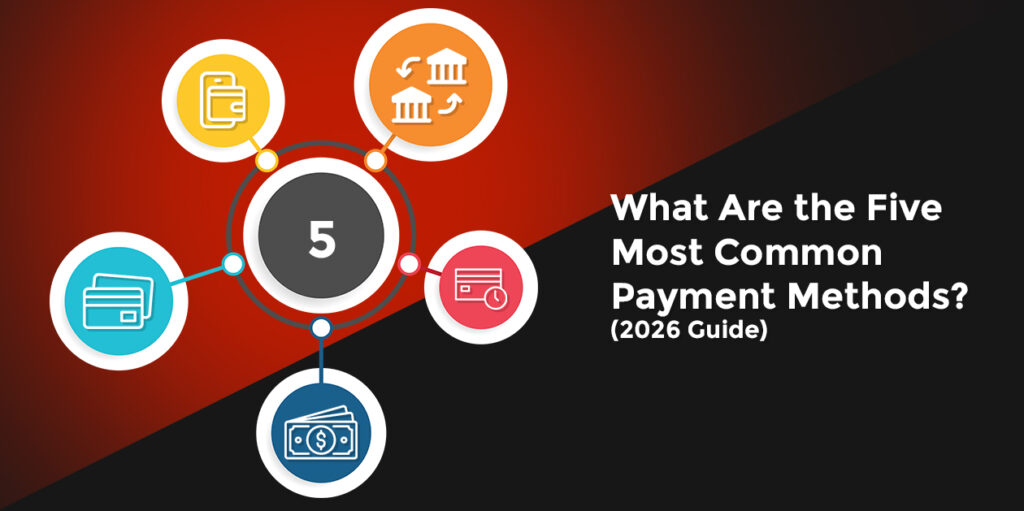
At a Glance: The Five Most Common Payment Methods
| Method | Best for | Typical settlement time | Typical merchant cost* | Growth trend |
| Credit & debit cards | In-store and online purchases of any size | 1–3 business days | ~1.5–3.5% per transaction | Stable, slowly losing online share |
| Digital wallets | Fast mobile and online checkout | Instant to 1 day | Varies by provider and funding source | Fastest-growing globally |
| Bank transfers / pay-by-bank | Larger payments, subscriptions, remittances | Instant to same-day | ACH: roughly | Rising sharply in open-banking markets |
| Buy Now, Pay Later (BNPL) | Discretionary and higher-ticket retail purchases | Instant approval, installments over weeks | ~3–6% of order value | Rapid growth, especially with younger consumers |
| Cash | Small, everyday, in-person purchases | Instant | No processing fee (handling and security costs apply) | Declining in developed markets, still dominant elsewhere |
*Indicative industry ranges. Actual rates depend on your provider, volumes, region, and contract.
Credit and Debit Cards
Cards remain the backbone of global commerce, even as newer methods gain ground. They’re accepted almost everywhere, from corner stores to international e-commerce sites, and decades of infrastructure have made them the default option for most in-person transactions. According to the Nilson Report, Visa-branded cards generated about 38.8% of all global card-network purchase transactions in 2023, with Mastercard, UnionPay, and American Express splitting most of the remainder.
Why people use them:
- Widely accepted online and in-store, with minimal setup required
- Built-in fraud protection and chargeback rights that put the burden of proof on the merchant, not the cardholder
- Rewards points, cashback, and credit-building benefits that other payment methods rarely match
- Familiarity: most consumers have used a card for years and trust the process
What they cost:
Card processing typically runs from roughly 1.5% to 3.5% of each transaction, depending on card type, region, and how the payment is processed. Nilson Report data cited by industry press puts the top end of merchant discount rates at around 3.5%.
Contactless cards:
Tap-to-pay isn’t a separate payment method; it’s a delivery mechanism for cards and wallets, using NFC technology. But it has changed in-store behavior enough to deserve attention. UK Finance has reported that contactless made up more than 70% of in-store card transactions in the UK by 2023, and contactless is used for roughly four in five card payments at the point of sale in Australia. For merchants, that means in-store terminals should support NFC as standard.
Where they’re losing ground:
Digital wallets have overtaken cards as the leading online payment method in many markets. Card fraud is also a persistent cost: the Nilson Report put global card fraud losses at $33.41 billion in 2024 and projects them to reach $41.06 billion by 2030. That’s a major reason merchants are investing in tokenization and 3D Secure 2.0 authentication, technologies that make card payments safer without adding friction for the shopper. For businesses, card acceptance is still non-negotiable, but it’s no longer enough on its own.
Digital Wallets (Apple Pay, Google Pay, PayPal, Alipay)
Digital wallets are now the single most common way people pay for things online, and they’re closing the gap in physical stores too. A wallet stores card or bank details behind biometric or PIN authentication, letting shoppers check out in one tap instead of typing in a 16-digit card number.
According to Worldpay’s 2026 Global Payments Report, digital wallets accounted for 56% of global e-commerce spend and 33% of in-person spend in 2025, making them the world’s leading way to pay.
Why they’re winning:
- Faster checkout than manually entering card details, which directly reduces cart abandonment
- Stronger security through tokenization: your real card number is never shared with the merchant, only a one-time token
- Dominant in mobile-first markets, especially across Asia-Pacific
- Built for cross-border use, letting shoppers pay in their preferred currency or method without extra steps
PayPal alone processed $1.79 trillion in total payment volume in 2025, up 7% from the year before, according to its FY2025 annual report, and a large share of that volume is cross-border, a key reason wallets matter so much for international sellers and remittance-focused businesses. In markets like China, Alipay and WeChat Pay have gone even further, becoming the default way consumers pay both online and offline. Worldpay’s Global Payments Report also notes that wallets can be funded by cards, bank accounts, or BNPL, which is why they’re sometimes called the “everything” payment method.
What they cost:
Wallet fees vary by provider and by what funds the wallet. A card-funded wallet payment generally carries card-like processing costs, while bank-funded or locally issued wallets may cost less.
For any business serving customers outside its home market, supporting at least one major digital wallet is quickly becoming table stakes rather than a nice-to-have.
Bank Transfers and Pay-by-Bank
Direct bank transfers, including ACH in the US, SEPA in Europe, and newer “pay-by-bank” services enabled by open banking, let customers pay straight from their bank account without entering card details or going through a card network at all.
Why people use them:
- No card network fees, which often means lower costs for both merchants and consumers
- Instant or same-day settlement in many markets, compared to the multi-day delay common with cards
- Easier budgeting and spend tracking, since money moves directly from checking accounts rather than through a revolving credit line
- Lower fraud exposure for merchants, since there’s no stored card number to be stolen
What they cost:
ACH payments typically cost merchants in the range of $0.20 to $1.50 per transaction, often far less than a percentage-based card fee on larger payments. Wire transfers carry higher flat fees but suit high-value and time-sensitive payments. If you need to move larger sums domestically, domestic wire transfers settle the same day and are irrevocable once sent.
Open banking adoption is accelerating:
In the UK, Open Banking Limited reports more than 16 million people now use open banking services, roughly one in three adults, and payments made through the system grew by more than 50% in 2025. Amazon UK and eBay have added pay-by-bank at checkout. (Note that this figure measures open banking users overall, not only people paying for purchases by bank.)
The Real-Time Rails Behind “Instant Settlement”
“Instant or same-day settlement” isn’t magic; it’s powered by specific real-time payment systems:
- FedNow and RTP (United States): The Federal Reserve’s FedNow service and The Clearing House’s RTP network allow account-to-account payments that settle in seconds, at any time of day.
- UPI (India): The Unified Payments Interface, run by NPCI, has grown to more than 20 billion transactions a month in 2026, and Worldpay’s 2026 report shows wallets accounting for 68% of India’s e-commerce spend, much of it UPI-driven.
- Pix (Brazil): Brazil’s central bank-run instant payment system had 174 million individual users as of March 2026, according to FXC Intelligence, and handled an estimated 40% of Brazil’s e-commerce volume in 2024 per PCMI estimates.
- PayNow (Singapore), PromptPay (Thailand), and DuitNow (Malaysia): Worldpay projects account-to-account payments will reach 13% of Singapore’s e-commerce and 15% of point-of-sale value by 2030.
- SEPA Instant (Europe): Real-time euro transfers across the SEPA zone.
For subscription businesses, marketplaces, and cross-border remittance platforms in particular, bank-based rails are becoming a preferred option because refunds settle just as quickly as payments do, and there’s no card-expiration problem to manage.
Buy Now, Pay Later (BNPL)
BNPL has grown from a niche checkout option into a mainstream payment method in under a decade. Providers like Klarna, Afterpay, and Affirm let shoppers split a purchase into interest-free installments, usually four payments over six weeks, approved instantly at checkout, typically without a hard credit check.
Key numbers:
- Worldpay’s 2026 Global Payments Report forecasts BNPL will reach $500 billion in global e-commerce value by 2030, and reports that BNPL already accounts for 6% of US e-commerce value.
- Industry estimates put global BNPL users at roughly 380 million in 2024, with usage still climbing.
- Adoption skews younger, making it a meaningful factor for brands targeting Gen Z and younger millennials.
What it costs:
BNPL is typically the most expensive method for merchants, with fees commonly in the range of 3–6% of the order value. Many merchants accept that cost because BNPL can lift average order value and conversion.
The caveat:
Regulators are paying closer attention as usage grows. Industry surveys suggest a notable share of BNPL users, in some studies roughly a third or more, report missing at least one payment, and default rates, while relatively low, are being watched closely by consumer protection agencies. Merchants should pair BNPL with clear terms and responsible lending partners so it works for customers, too.
Cash:
It may not be flashy, but cash hasn’t disappeared. It’s still the most accessible payment method for people without bank accounts or smartphones, and it remains dominant for small, everyday, in-person purchases in many parts of the world, from street markets to informal economies where digital infrastructure is still catching up.
Why it persists:
- No transaction fees, processing delays, or dependence on a working internet connection (though businesses still bear costs for handling, counting, and securing cash)
- Works without a bank account, credit history, or a smartphone, a genuine necessity for the world’s unbanked population
- Preferred by consumers who want to avoid overspending, protect their privacy, or simply prefer the tactile certainty of physical money
- Universally accepted with zero technical setup, which matters enormously in emergencies or areas with unreliable connectivity
Cash usage is declining fastest in digitally advanced economies like Sweden and South Korea, but globally it’s still a meaningful share of consumer transactions. That’s exactly why many merchants, especially in emerging markets, can’t afford to go fully cashless without cutting off a real segment of potential customers.
How Payment Preferences Differ by Region
Payment habits vary dramatically by market. A method that dominates in one country can be almost irrelevant in another, which is why a single global checkout rarely works.
| Market | Leading method(s) | Key data point |
| United States | Digital wallets online; cards in store | Wallets were 40% of US e-commerce value and credit cards 32% in 2025 (Worldpay GPR 2026). Wallets were 17% of in-store value. |
| United Kingdom | Cards (contactless in store), with pay-by-bank rising | Contactless exceeded 70% of in-store card transactions by 2023 (UK Finance); 16M+ open banking users (Open Banking Limited) |
| Germany | PayPal, bank-based and invoice-style methods | Consumers commonly favor bank transfer or BNPL-style options online (Gr4vy, 2026) |
| China | Digital wallets (Alipay, WeChat Pay) | Wallets accounted for 89% of online and 87% of point-of-sale value in 2025 (Worldpay GPR 2026, as reported by Akurateco) |
| Brazil | Pix | Pix handled about 40% of e-commerce volume in 2024 (PCMI estimate) |
| India | UPI and UPI-based wallets | Wallets were 68% of e-commerce and 61% of POS spend (Worldpay GPR 2026) |
Asia-Pacific is the world’s most wallet-led region: Worldpay reports wallets made up 77% of online spend and 63% of in-person spend there in 2025. In the US, cards still anchor spending, but wallets lead online.
Other Payment Methods to Watch
Beyond the big five, two other methods deserve a mention.
Cryptocurrency and Stablecoins
Crypto isn’t among the five most common methods by volume, but stablecoins in particular are gaining attention for payments. Worldpay’s 2026 Global Payments Report describes crypto as a developing payments story, with stablecoins showing the clearest potential for cross-border use cases, where speed and cost matter most. Because stablecoins are pegged to currencies like the US dollar, they avoid much of the price volatility that keeps most merchants away from other cryptocurrencies.
For businesses that need to move money across borders, stablecoin settlement can shorten timelines and reduce intermediaries. PRETpayments’ payment gateway supports stablecoin conversion and settlement alongside traditional banking rails.
Checks:
Checks are declining but haven’t disappeared. They’re still used for some business-to-business payments, rent, and certain service industries, where established processes and paper-based approvals persist. For most businesses, they’re a legacy method to support only where customers or suppliers require it, since they’re slower to clear and easier to lose or defraud than electronic alternatives.
Which Payment Methods Should Your Business Offer?
There’s no single right answer. The best mix depends on your customers’ region, age group, purchase size, and how much of your business is cross-border. A domestic retail store may do fine with cards, a wallet, and cash. A cross-border e-commerce or remittance business, on the other hand, typically needs cards, at least one major digital wallet, and a local bank-transfer option at minimum, since forcing international customers onto unfamiliar payment rails is one of the biggest drivers of abandoned checkouts.
International businesses also need somewhere to actually hold and move funds. A USA bank account for international businesses gives overseas companies a way to collect US dollar payments and settle them through bank transfers.
A useful rule of thumb: match your payment options to how your specific audience already prefers to pay, rather than defaulting to whatever your payment processor supports out of the box. Related reading: see our guide on choosing the right payment gateway for your business and our breakdown of how remittance and cross-border payment software works. You can also see the full range of banking, payment, and compliance services on the PRETpayments capabilities page.
Frequently Asked Questions
1. What is the most commonly used payment method worldwide?
Digital wallets have overtaken cards as the leading payment method for online purchases globally, at 56% of e-commerce spend in 2025 according to Worldpay, driven largely by mobile-first markets in Asia-Pacific. Cards still lead for in-person transactions in many Western markets.
2. Is cash still a common payment method?
Yes. While its share is shrinking in digitally advanced economies, cash remains essential for everyday purchases in many parts of the world, particularly for people without bank access or reliable internet.
3. What payment method is growing fastest?
Digital wallets and real-time account-to-account payments, including open banking pay-by-bank, are among the fastest-growing methods. BNPL is also growing quickly, though it typically costs merchants more than cards rather than less. Bank-based methods benefit from lower fees and faster settlement than traditional cards.
4. Should a small business accept all five payment methods?
Not necessarily. Start with cards and one digital wallet, then add bank transfers or BNPL based on what your actual customer data shows they want. Adding options that go unused just adds complexity without boosting conversion.
5. How much does it cost to accept each payment method?
Indicatively, cards cost roughly 1.5–3.5% per transaction, ACH roughly 1.50 per transaction, and BNPL roughly 3–6% of the order value. Wallet fees vary by provider and funding source, and cash has no processing fee but does carry handling costs. Actual rates depend on your provider and volumes.
6. What is contactless payment?
Contactless payment, often called tap-to-pay, uses NFC technology to let customers pay by tapping a card, phone, or wearable at a terminal. It’s not a separate payment method but a way to pay with cards and digital wallets.
7. Are stablecoins a common payment method?
Not yet by volume, but they’re a rising option for cross-border payments because they can settle quickly and are pegged to stable currencies like the US dollar.
The Final Thought
Cards and digital wallets dominate global spend today, bank transfers and BNPL are the fastest-growing alternatives, and cash still holds a meaningful place for millions of consumers, while stablecoins and real-time rails hint at where payments are heading. Businesses that support a well-chosen mix of these methods tend to see fewer abandoned carts, lower fraud exposure, and broader customer reach, while those that stick to a single option risk losing customers to competitors who simply make it easier to pay.
Ready to Simplify How You Accept or Send Payments?
Talk to our team about building a payment setup that fits your customers, whether that means adding a new wallet option, accepting cross-border bank transfers, or reducing your checkout drop-off rate. Contact PRETpayments to get started, or explore our capabilities.
2 thoughts on “What Are the Five Most Common Payment Methods? (2026 Guide)”