Payment settlement is the final step of a payment, when money actually moves between financial institutions and the recipient’s account is credited. It comes after authorization and clearing. Until settlement is complete, a payment is only a promise to pay. How long it takes depends on the payment rail, the cutoff times, and the banks involved.
The gap between “payment sent” and “funds available” is where settlement happens. At PRETpayments, settlement sits at the center of the infrastructure we build with approved sponsor-bank and fintech partners, so here is how it works from the ground up.
Key Takeaways
- Settlement is the actual transfer of funds. Clearing only confirms and calculates what is owed.
- Each rail settles differently: ACH in batches, wires and instant payments one payment at a time, cards in netted totals, stablecoins on-chain.
- A “completed” status in an app does not always mean the money has settled.
- For fintechs, settlement quality shows up in cash flow, reconciliation effort, and customer trust.
What Is Payment Settlement?
Payment settlement is the process that discharges a payment obligation by moving value from the payer’s side to the payee’s side. In practice, that means one bank (or a central bank system) debits one account and credits another so the books on both sides agree.
The Bank for International Settlements describes clearing as the stage that transmits, reconciles, and sometimes nets payment orders before settlement happens. Settlement is what follows.
Why settlement is not the same as “payment received”
A customer can see “paid” in an app while the underlying funds are still in transit. Clearing confirms what is owed, and settlement moves the money, so a payment can be cleared without being settled. That is why finance teams track settlement status separately from payment status. I see this gap most often when a platform shows a balance before the sponsor bank has finished its own processing.
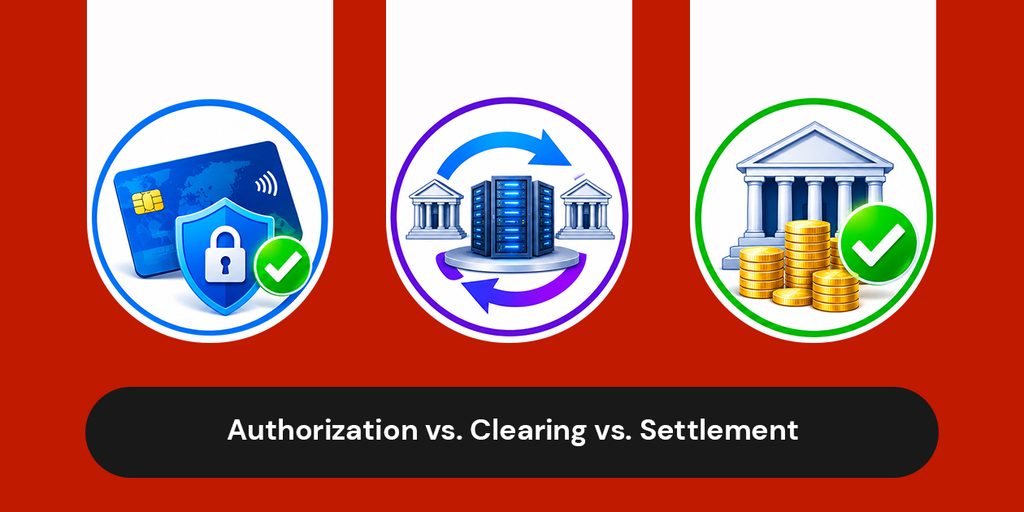
Authorization vs. Clearing vs. Settlement
These three terms are often mixed up. This table keeps them apart.
| Stage | What happens | Money moves? |
| Authorization | The payer’s bank or issuer approves or declines the request | No |
| Clearing | Banks exchange transaction details and calculate who owes what | No |
| Settlement | Funds transfer between institutions and the recipient is credited | Yes |
The card version follows the same logic: the acquirer batches the day’s transactions, the card network nets the positions, and the acquirer receives the net amount owed.
How the Payment Settlement Process Works?
The exact path depends on the rail, but most payments follow the same logic.
- Initiation: The payer or payer’s platform creates the payment instruction.
- Authorization or validation: The institution checks the account, funds, and risk rules.
- Clearing: Payment details are exchanged, matched, and netted where the rail allows it.
- Settlement: Funds move between institutions, either individually (gross) or as netted totals.
- Posting and availability: The receiving bank or program credits the account, and the funds become usable.
- Reconciliation: The business matches the settled amount against its own ledger and reports.
That last step matters more than most teams expect. If your internal ledger and your bank settlement records disagree, you spend time chasing differences instead of growing. The 2024 Synapse bankruptcy shows how costly that gap can become: its ledger and its partner banks’ records could not be reconciled, and many end users lost access to their funds for months, as this Synapse case study explains.
Where the Sponsor Bank Fits in Payment Settlement?
A sponsor bank is the chartered bank that holds the accounts and gives a fintech access to the payment rails. That is why BaaS differs from traditional banking: the fintech owns the customer experience, while the bank remains the regulated entity behind the money. Sponsor banks also oversee fintech programs closely, and AML compliance is a major part of that work.
Settlement is where that role shows up in practice, because the sponsor bank is the institution that receives and posts the funds.
How Long Does Payment Settlement Take?
Settlement time is set by the rail, not by the app on top of it.
| Rail | How it settles | Typical timing |
| Standard ACH | Batched through the ACH network | Debits settle the same or next banking day; credits settle within two banking days at most |
| Same Day ACH | Three submission windows per business day | Same business day, up to $1 million per payment |
| Wire (Fedwire) | Real-time gross settlement, one payment at a time | Immediate once processed, and final |
| Instant payments (FedNow, RTP) | Each payment settles individually, 24/7/365 | Seconds, and final once confirmed |
| Card payments | Cleared in batches, then netted between issuer and acquirer | Set by the processor and acquirer, so confirm the schedule in your agreement |
| Stablecoin | On-chain transfer, then conversion if fiat is needed | Minutes on-chain, but the bank leg follows bank timing |
A few verified details behind that table:
- Standard ACH: Nacha estimates that about 80% of ACH payments settle within one banking day or less. Debits settle the same or next banking day, and credits cannot settle more than two banking days out. Funds availability at the receiving bank can add time, and nothing settles on weekends or federal holidays.
- Same Day ACH: The Federal Reserve’s FedACH schedule shows three same-day windows. Files submitted by 10:30 a.m., 2:45 p.m., and 4:45 p.m. Eastern settle at 1:00 p.m., 5:00 p.m., and 6:00 p.m. Eastern. Nacha’s rules set the per-payment limit at $1 million, and payments above it move to next-day settlement.
- Fedwire: The Federal Reserve describes the Fedwire Funds Service as a real-time gross settlement system where settlement is immediate, final, and irrevocable. A Federal Reserve notice in the Federal Register (90 FR 51356, November 17, 2025) states that it handles individual transfers up to one penny less than $10 billion.
- Instant payments: The Clearing House has run the RTP network since 2017, and the Federal Reserve launched FedNow in July 2023. Both operate around the clock, every day of the year, and each payment settles individually and is final once confirmed. The RTP limit rose to $10 million on February 9, 2025, and the FedNow network limit rose to $10 million in November 2025, though banks often set lower limits for their customers.
- Cards: Settlement timing varies by processor and acquirer, and each provider publishes its own schedule, so confirm yours.
These timings apply to U.S. rails. Euro payments follow different rails: SEPA Credit Transfer settles within one business day, while SEPA Instant Credit Transfer targets ten seconds, around the clock. Do not assume ACH timing applies outside the United States.
Individual banks also set their own limits and cutoffs, which are often tighter than the network rules. Always check the bank’s schedule rather than assuming the network maximum applies to your account.
Why Payment Settlement Matters for Fintechs?
Scale makes this matter. The ACH Network alone carried 35.2 billion payments worth $93 trillion in 2025, according to Nacha’s January 2026 release, so small timing gaps add up quickly. For any payment platform, settlement shapes four things.
- Cash flow: Faster settlement means funds are usable sooner, which lowers the working capital you need to prefund payouts.
- Reconciliation: Clean settlement data makes it easier to match every customer balance to real bank money, which is the core of treasury management for a fintech.
- Risk: Settlement is where counterparty, timing, and return risk show up. ACH payments, for example, can be returned after initial processing.
- Customer trust: Users judge your product by when funds are actually available, not by what the status label says. That is especially true for platforms and marketplaces that offer accounts or payouts to their own users, the model behind embedded finance.
This is also why the right payment infrastructure has a direct effect on how fast a business can expand into new markets.
How We Handle Settlement at PRETpayments?
At PRETpayments, we connect approved fintechs, MSBs, and platforms with sponsor-bank and fintech partners that support U.S. market entry, account access, payments, and compliance workflows. Settlement is one of the workflows we help programs run, alongside ledgering, funds movement, and transaction orchestration.
Here is how that looks in practice:
- Named U.S. accounts: We help eligible programs issue named accounts that are located in the USA and described as FDIC insured on our site. These named bank accounts can receive domestic and international payments.
- Bank-visible infrastructure: Our Level 1 BaaS model keeps payments, ledgering, reporting, and compliance workflows in one bank-visible layer, which makes settlement easier to trace.
- Domestic USD rails: Our programs support ACH pull and push and wire transfers, and our team can explain which rail fits which use case.
- Stablecoin and bank rails together: We help approved programs connect stablecoin wallets, on/off ramps, USD accounts, liquidity, and settlement workflows so digital-asset flows can sit next to traditional banking.
I want to be clear about one point. Settlement timing for any program depends on the rail, the sponsor bank’s cutoffs, and the approvals in place. We will not promise a single number before we understand your flows.
Illustrative example: one ACH payout from instruction to posted balance
This is a simplified example, not a client case. Timing depends on the rail, the sponsor bank’s cutoffs, and the approvals in place.
- A platform’s user requests a payout, and the platform sends the instruction to us through the API.
- Our ledger checks that the program’s funded balance covers the payout and records the pending debit.
- Compliance checks, such as sanctions screening and transaction monitoring, run before funds move.
- The instruction goes to the sponsor bank, which sends it into the ACH network as a credit. A standard credit settles on the next banking day or within two banking days. A Same Day ACH credit can settle at 1:00 p.m., 5:00 p.m., or 6:00 p.m. Eastern if it meets the matching cutoff.
- On the settlement date, the ACH operator settles between the sending bank and the receiving bank.
- The recipient’s bank posts the credit to the account, and its funds availability rules can add time.
- Our ledger marks the payout as settled, and the settlement report ties the platform’s records to the bank’s records.
The point of the trace is step 7. The platform, the ledger, and the bank all show the same outcome, so reconciliation has one trail to follow.
Ledger balance vs. settled funds:
A ledger balance is the number your platform shows. Settled funds are what the sponsor bank has actually received and posted. Good programs keep the two aligned and show customers which is which. A virtual IBAN is a useful comparison, because it points to an account structure rather than creating a separate bank account.
Stablecoin Settlement and the Bank Bridge

Stablecoins can settle on-chain in minutes at any hour, which is attractive for cross-border flows. The catch is the fiat leg. When a business needs U.S. dollars in a bank account, the on-chain transfer still has to be converted and credited through a bank rail.
That is the gap we focus on. Our stablecoin work connects wallets and on/off ramps to U.S. dollar accounts through approved banking and infrastructure partners, so teams do not have to run two disconnected systems.
One compliance point is worth stating plainly. The GENIUS Act, signed into law on July 18, 2025 as Public Law 119-27, says payment stablecoins are not subject to FDIC deposit insurance. It also makes it unlawful to represent them as federally insured. So a stablecoin balance is not the same as an FDIC-insured deposit. FDIC insurance applies to eligible deposits at insured banks, up to $250,000 per depositor, per insured bank, per ownership category. Keep this distinction clear in your customer disclosures.
Common Payment Settlement Risks and How to Reduce Them
- Missed cutoffs: A payment submitted a few minutes late can slip a full business day. Build cutoff times into your product logic.
- Returns and reversals: ACH items can come back after you thought they were final. Hold funds or set risk limits until the return window passes.
- Reconciliation gaps: Use a single ledger and daily settlement reporting so differences surface early.
- Compliance exposure: KYC, KYB, and transaction monitoring must run before funds move, not after.
- Partner dependency: Know which bank holds the funds, who your program manager is, and what happens if a partner changes.
How to Choose a Settlement Partner?
Ask these questions before you sign anything:
- Which rails are supported, and what are the cutoff times for each?
- Is the account a true named account or a virtual structure on a pooled account?
- How is settlement data reported, and can it reconcile to my ledger automatically?
- What compliance checks apply during onboarding and ongoing monitoring?
- Who is the sponsor bank, and what oversight model do they use?
- How is pricing set? Our plan pricing reflects program scope, so it helps to have your volumes and corridors ready.
Which rails your product needs first depends on how your customers already pay, so it helps to compare the most common payment methods in your target market before you choose a partner.
Frequently Asked Questions
1. What is payment settlement in simple terms?
Payment settlement is the final transfer of money between banks after a payment has been approved and cleared. It is the point where the recipient’s account is actually credited.
2. What is the difference between clearing and settlement?
Clearing exchanges and reconciles transaction details and works out what each party owes. Settlement moves the money that clearing calculated. Clearing happens first, settlement second.
3. How long does payment settlement take?
It depends on the rail. Standard ACH debits settle the same or next banking day and credits within two banking days at most, per Nacha. Same Day ACH settles within the same business day through three windows, and Fedwire wires settle in real time once processed. Card settlement depends on the processor, and instant payments through FedNow and RTP settle in seconds.
4. What is settlement finality?
Settlement finality is the point at which a payment becomes irrevocable. The Federal Reserve describes Fedwire settlement as final and irrevocable once processed. Other rails, such as ACH, allow returns within defined rules.
5. Is payment settlement the same as a payout?
No. Settlement moves funds between institutions. A payout is the step where a platform or processor sends the settled funds on to a merchant’s or customer’s bank account.
6. What is a settlement account?
A settlement account is a bank account used to receive, hold, and move the funds that result from settled payments. In sponsor-bank programs, accounts are held at the bank and tracked in the fintech’s ledger.
7. How does stablecoin settlement work with bank accounts?
Stablecoins transfer on-chain, then convert to U.S. dollars through an on/off ramp and credit to a bank account. The on-chain step can be fast, but the bank credit follows the bank’s own rails and cutoffs.
8. Are stablecoin balances FDIC insured?
No. The GENIUS Act states that payment stablecoins are not subject to FDIC deposit insurance, and it is unlawful to represent them as federally insured. FDIC coverage applies to eligible deposits at insured banks, not to stablecoin balances.
9. Can PRETpayments help with payment settlement?
Yes. We help approved fintechs, MSBs, and platforms access sponsor-bank accounts, domestic USD payments, payouts, settlement, and compliance workflows, with the option to add stablecoin wallets, ramps, or treasury tools later. Our average onboarding time is about three business days.
10. How do FedNow and RTP differ from ACH settlement?
FedNow and RTP settle each payment individually in seconds, around the clock, and the settlement is final. ACH settles in batches on banking days, and returns are possible within defined rules. Both instant networks now support payments up to $10 million, though banks often set lower limits for their customers.
Ready to Build on Reliable Settlement?
If you are planning a payment program and want to understand how settlement would work for your flows, I would be glad to walk through it with you.
If you are ready, you can start your corporate application and we will review your program. If you would rather talk through rails, accounts, and timelines first, we can set up a call. For a specific question, our team is happy to answer it before you decide.