It is the practice of building financial services, such as payments, bank accounts, lending, or insurance, directly into the software a customer already uses. The customer finishes a financial task inside the app or platform, instead of being sent to a separate bank or payment site.
You have probably used it without noticing. A ride-hailing app charges your card and pays the driver. A shopping platform offers financing at checkout. A business software tool lets a company pay suppliers without leaving the dashboard. This guide explains the embedded finance definition, how it works, what embedded payments are, how platforms earn money from them, and where the market and the rules stand in 2026.
Key Takeaways:
- Embedded finance means offering financial services inside a non-financial product, usually through APIs and a regulated bank partner.
- Embedded payments are the most common type. Market research ranks payments as the largest embedded finance segment.
- The main benefits of embedded payments are new revenue, a smoother customer experience, faster payouts, and clearer data.
- 2026 market size estimates range from about $86 billion to about $199 billion, because research firms define the market differently.
- The platform stays responsible for its customers even when a bank partner holds the license. Partner choice and compliance matter as much as features.
Definition of Embedded Finance:
The embedded finance definition most providers use is simple: financial services built into the products and workflows of companies that are not banks. Plaid describes it as bringing payments, lending, or banking into non-financial offerings, so users reach those services through tools they already use.
Three parties usually make that possible:
| Party | Role | Example |
| The platform | Owns the customer relationship and the product experience | A marketplace, a software tool, a gig-work app |
| The infrastructure provider | Supplies the APIs, accounts, ledger, and compliance tooling | A payments infrastructure company |
| The regulated bank | Holds the charter and the deposit accounts | A sponsor bank |
Show Image
The platform designs the experience. The infrastructure provider and the bank do the regulated work behind it.
Embedded Finance vs. Related Terms:
The terms overlap, so it helps to separate them.
| Term | What it means |
| Embedded finance | The outcome: financial services offered inside a non-financial product |
| Embedded payments | One type of embedded finance: payments built into the platform |
| Banking as a service (BaaS) | The infrastructure model that lets a licensed bank’s services be accessed through APIs |
| Payment gateway | The technology that authorizes and routes a payment, often one piece of a larger setup |
How Embedded Finance Works?
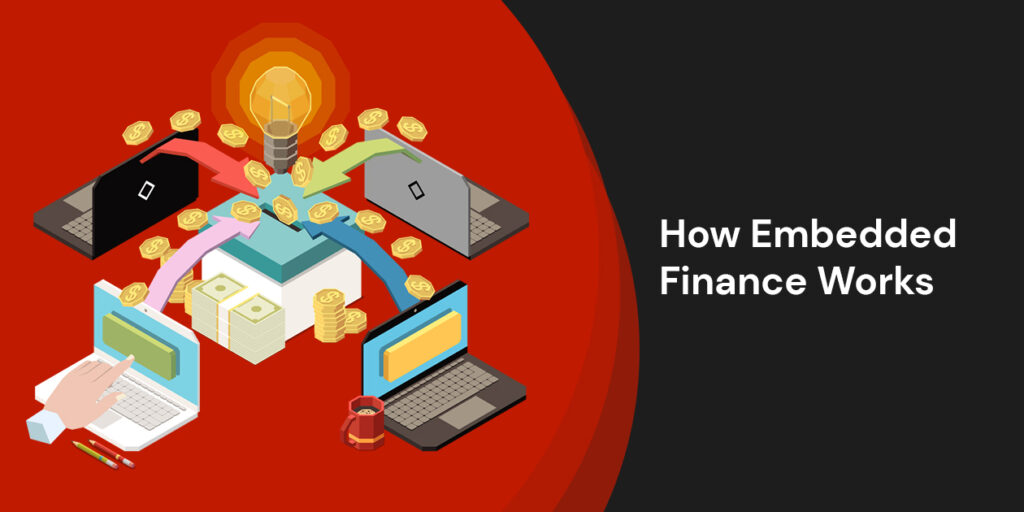
Most embedded finance programs follow the same path:
- Choose the feature. The platform decides what its users need, such as accepting payments, holding balances, or paying sellers.
- Integrate through APIs. Developers connect the platform to an infrastructure provider.
- Onboard users. Customers or businesses pass identity checks, known as KYC for individuals and KYB for businesses.
- Open accounts. Named accounts and balances are set up and recorded in a ledger, held with a regulated bank.
- Process and screen transactions. Each payment is checked against sanctions lists and monitored for unusual activity.
- Settle and reconcile. Funds move, balances update, and the platform sees the result through reports and webhooks.
The customer only sees steps one and six: a button in the app and a result.
Types of Embedded Finance:
| Type | What it does | Everyday example |
| Embedded payments | Accepts or sends money inside the platform | In-app checkout, seller payouts |
| Embedded banking | Gives users accounts, cards, or balances | A business app with its own account |
| Embedded lending | Offers credit at the point of need | Buy now, pay later at checkout |
| Embedded insurance | Sells cover alongside a purchase | Extended warranty added to an order |
| Embedded investments | Lets users invest inside another app | Buying a fractional share in a shopping or banking app |
Payments come first for most platforms because every business already needs to take or send money. Market research reflects that. Mordor Intelligence reported that payments held about 44% of the embedded finance market in 2025, and Polaris Market Research put the embedded payment segment at about 37%. The two firms measure the market differently, but both rank payments first.
What Are Embedded Payments? Embedded Payments Meaning
Embedded payments are payment features built directly into a platform’s own software, so users can pay or get paid without leaving it or being sent to another provider’s page. The platform controls the experience under its own brand, and it can earn revenue on the volume it processes.
Embedded Payments Meaning: A Plain-Terms Example
Picture a ride-hailing app. The rider taps “confirm,” the app charges the saved payment method, and the driver’s earnings update in the same app. Nobody types a card number into a separate site, and the app never hands the customer to a third party. That is the embedded payments meaning in practice: the payment is part of the product, not a detour from it.
Embedded Payments vs. Traditional Checkout
| Traditional checkout | Embedded payments | |
| Where payment happens | Often a redirect or a third-party page | Inside the platform’s own screens |
| Branding | Provider’s brand is visible | Platform’s brand throughout |
| Who owns the experience | Shared with the payment provider | The platform |
| Typical platform role | Merchant | Platform that onboards and pays its own users |
| Revenue | Platform pays fees | Platform can earn a share of payment revenue |
Payments are not only about collecting money. Paying people matters just as much. Marketplaces, payroll tools, and gig platforms depend on moving funds out quickly and accurately.
How Do Platforms Make Money From Embedded Payments?
The answer depends on the model, and the economics are set by contracts and card network rules, so confirm the details with any partner.
| Model | How it works | Platform’s role |
| Referral or revenue share | The platform sends its users to a payment processor and receives a share of the fees | Lightest: the processor handles onboarding and compliance |
| Payment facilitator (PayFac) | The platform, or its provider, onboards sub-merchants under a master merchant account and sets its own pricing | Heavier: more control over onboarding, funding, and pricing, and more risk and compliance duty |
| Account and money-movement programs | The platform charges per transaction or through a subscription for ACH, wire, and payout features, and may share revenue on card spend or balances, depending on the partner agreement | Depends on the program and the bank partner |
A payment facilitator is one way to deliver embedded payments, not a synonym for it. Many platforms start with a lighter model and move toward more control as volume grows.
Embedded Payment Processing: How It Works?
Embedded payment processing covers everything that happens between a customer’s tap and the money landing in the right account. The usual flow looks like this:
- Initiation. The user starts a payment in the platform, for example by choosing a saved account or card.
- Authorization or instruction. The payment is approved if it is a card, or instructed if it is a bank transfer.
- Screening. Compliance checks and fraud rules run before funds move.
- Routing. The platform’s provider picks the rail: card network, ACH, wire, or a real-time rail.
- Settlement. Funds arrive in the receiving account. This is where the banking layer matters most.
- Reconciliation and reporting. Each payment is matched to an invoice or order, and the platform is notified.
Different rails suit different jobs:
| Rail | Typical speed | Best for |
| Cards | Authorized in seconds, settled later | Consumer and online purchases |
| ACH | Usually next business day; Same Day ACH can settle within hours, up to $1 million per payment | Payroll, recurring and batch payments |
| Wire (Fedwire) | Same day; each payment settles individually and is final and irrevocable | High-value or time-sensitive payments |
| FedNow and RTP | Seconds, around the clock; FedNow’s network limit rose to $10 million on November 12, 2025 | Instant payouts and urgent transfers |
A platform that only has card acceptance can collect, but it cannot always pay out or hold funds. A payment gateway that hands captured funds straight into account infrastructure closes that gap. So does having domestic wire transfers and account settlement in the same system, for platforms that move money in both directions.
What Are the Benefits of Embedded Payments?
The main benefits of embedded payments are new revenue, a smoother customer experience, faster payouts, and cleaner data, balanced by added compliance responsibility.
For platforms:
- New revenue. The platform can earn a share of payment volume instead of only paying fees.
- Better conversion and retention. Fewer redirects and fewer steps mean fewer abandoned payments. Users who handle money inside a product are also less likely to leave it.
- Faster payouts. Sellers, drivers, and contractors get paid sooner, which improves loyalty on the supply side.
- Cleaner data. The platform sees the full payment record, which helps with reporting, support, and risk decisions.
- Less manual work. Automated settlement and reconciliation replace spreadsheets and bank portal checks.
For users:
- Convenience. Everything happens in one place.
- Speed. Payments and payouts complete with fewer steps.
- Clarity. Status and history sit alongside the activity they relate to.
The trade-off. The platform takes on more responsibility. It must choose a trustworthy partner, support its users, and meet compliance obligations that come with handling money.
Embedded Payments Examples
| Example | How embedded payments work |
| Ride-hailing and delivery apps | Riders pay in the app, and drivers receive payouts through the same platform |
| Marketplaces | Buyers pay once, and the platform splits funds to sellers |
| Vertical software (restaurants, salons, property managers) | The software takes payments, collects rent, or pays vendors inside its own tools |
| Digital wallets | Apple Pay and Google Pay let users pay inside apps and stores |
| B2B invoice and procurement tools | Companies approve and pay supplier invoices without leaving the platform |
| Commerce platforms | Shopify offers its own payments and financing to merchants |
Nuvei names Apple Pay and Google Pay as well-known examples, and Value Add VC lists Shopify among the companies running embedded finance at scale.
An illustrative scenario:
A freight-matching platform connects shippers and carriers. Before embedding payments, shippers paid carriers by check, and carriers waited weeks. After adding embedded payments, shippers pay inside the platform, and the platform pays carriers by wire or ACH once a delivery is confirmed. The platform now sees every payment, reconciles automatically, and can earn a share of the volume. This scenario is invented to show the idea. It is not a customer result.
Embedded Finance Use Cases by Industry
These embedded finance use cases show where platforms add payments, accounts, or credit first:
| Industry | Embedded finance use case | Product type |
| Marketplaces | Split payments and seller payouts | Payments |
| Software (SaaS) | Subscription billing, in-app payments, payouts to users | Payments, banking |
| Logistics and freight | Pay carriers on delivery | Payments |
| Property management | Rent collection and owner disbursements | Payments, accounts |
| Healthcare | Patient payments and provider payouts | Payments |
| Retail and e-commerce | Checkout financing and instant refunds | Lending, payments |
| Gig and creator platforms | Fast payouts to workers | Payments, banking |
| Fintech and international platforms | Named bank accounts and settlement across borders | Banking, payments |
Fintechs and cross-border platforms often need something harder to build than a payment button: real bank accounts. That is where named U.S. bank accounts built through a sponsor bank come in.
Planning an embedded finance program and not sure where the banking layer fits?
Contact our team to talk through accounts, settlement, and payouts for your platform.
Embedded Finance Market Size in 2026
How big is embedded finance? It depends on who is counting. Some firms count only the revenue earned by platforms and enablers. Others count the full value of transactions that flow through embedded products. That is why published 2026 estimates differ so much:
| Source | 2026 estimate | Growth outlook |
| Future Market Insights | About $85.8 billion | 15.8% CAGR to 2036 |
| Mordor Intelligence | About $156 billion | 23.8% CAGR to 2031 |
| Polaris Market Research | About $190 billion | 32.6% CAGR to 2034 |
| Knowledge Sourcing Intelligence | About $199 billion | 36.2% CAGR to 2031 |
Treat these as a range, not a single fact. They agree on direction: the market is growing quickly, and payments lead it.
What’s Changing in 2026?
- Payments still lead, but other segments are growing faster. Mordor Intelligence projects the investments category to grow at about 27.7% a year through 2031, ahead of payments.
- Instant payments are scaling. The Federal Reserve raised the FedNow network limit to $10 million in November 2025. In October 2025, it also announced plans to expand Fedwire’s operating days to include Sundays and weekday holidays, with use of the added days voluntary.
- Stablecoin rules are taking shape. The GENIUS Act, signed on July 18, 2025, created a federal framework for payment stablecoins. According to Morrison Foerster’s summary, it takes effect on the earlier of 18 months after enactment or 120 days after final regulations. Platforms that plan to use stablecoin settlement should follow the rulemaking.
- Bank and fintech oversight is tightening. See the FDIC proposal below.
Risks and Regulation: What to Know in 2026?

Embedded finance works because a regulated bank sits behind the platform. That partnership brings obligations, and the rules are still being tightened.
- The bank partner stays accountable. US banking agencies have looked closely at bank and fintech relationships and have taken enforcement actions in connection with some programs, as Mayer Brown noted when the FDIC proposed new recordkeeping requirements.
- Recordkeeping is under review. In September 2024, the FDIC proposed a rule that would require banks to keep detailed, owner-level records for certain custodial accounts used in bank and fintech programs. It was published in the Federal Register on October 2, 2024, and the comment period closed on January 16, 2025. As of October 22, 2026, we found no final rule. The FDIC’s regulatory agenda entry lists it as a long-term action with the final rule date to be determined, so check for updates before you design around it.
- Deposit insurance has limits. FDIC insurance protects depositors if an insured bank fails. It does not protect against the failure of a fintech or platform, and pass-through coverage depends on conditions being met.
- Money movement can trigger licensing questions. In some structures, a platform that moves customer funds may itself fall under money transmitter rules. FinCEN’s money services business definition explains who is covered, and legal counsel should review your structure.
- Compliance still applies. KYC, KYB, sanctions screening, transaction monitoring, and Bank Secrecy Act and anti-money laundering controls apply to programs that move money.
- Fraud and dependency. A platform that embeds payments takes on fraud exposure and depends on its partners staying reliable.
How to Choose an Embedded Finance Partner?
Ask any provider these questions before you commit:
- Which regulated bank holds the accounts, and how many banking relationships does the provider have?
- Does the provider support both inbound and outbound money movement through one integration?
- Does compliance screening happen before funds move?
- Can you see status, settlement, and reconciliation data in one place, through APIs and webhooks?
- How are accounts structured, and can they support multiple entities or sub-programs as you grow?
- How does the provider keep records at the user level, given the direction of the FDIC proposal?
- What happens to funds if something goes wrong?
How to Get Started With Embedded Finance?
- Define the money flows. List who pays whom, in what currency, and how fast, so you know which rails you need.
- Pick the starting feature. Begin with the one that solves a real user problem, usually collecting payments or paying out.
- Choose a partner. Use the checklist above, and check how accounts, compliance, and reconciliation fit together. Our platform capabilities page shows one example of how that stack can be put together.
- Split the compliance duties in writing. Agree who handles KYC, screening, monitoring, disputes, and customer support.
- Build, test, and launch in phases. Test onboarding, webhooks, returns, and reconciliation before you scale, then watch fraud and failed-payment rates after launch.
How PRETpayments Supports Embedded Finance?
We provide the banking and settlement layer behind embedded finance programs. Our approach is built on sponsor-bank relationships, so approved programs can offer accounts and money movement without holding their own banking charter. Funds move through deposit accounts at our sponsor bank, a Member FDIC institution, and pass-through deposit insurance is available up to $250,000 per depositor, subject to certain conditions.
Here is what that looks like in practice:
- Named accounts. We support named U.S. accounts for platforms, including non-U.S. fintechs that lack their own U.S. banking relationship.
- Money movement through one API. Domestic wires run through Fedwire, with compliance checks before funds leave and webhooks for status.
- Connected acceptance and settlement. Our payment gateway hands captured funds straight into account infrastructure instead of dead-ending at authorization.
- Compliance built in. Our compliance program covers KYB and KYC, beneficial ownership verification, sanctions screening, and transaction monitoring in line with BSA and AML requirements.
- A modular start. A smaller program can begin with core accounts and payments, then add multi-entity structures and other capabilities, including stablecoin settlement, as it grows.
We are infrastructure for approved fintechs, marketplaces, and platforms. We are not a card acquirer or a consumer checkout product, and each program stays responsible for its own users and compliance obligations.
Frequently Asked Questions
1. What is the difference between embedded finance and banking as a service?
Banking as a service is the infrastructure model that lets a licensed bank’s services be reached through APIs. Embedded finance is what the end customer experiences when a platform uses that infrastructure to offer financial features inside its own product.
2. How do platforms make money from embedded payments?
Platforms earn through a revenue share with a processor, a markup under a payment facilitator model, or per-transaction and subscription fees on account and money-movement features. The exact economics depend on the partner contract and card network rules.
3. What is a payment facilitator, and is it the same as embedded payments?
No. A payment facilitator onboards sub-merchants under its own master merchant account and sets its own pricing. It is one way to deliver embedded payments. Platforms can also use lighter referral models or account-based money-movement programs.
4.Do I need a banking license to offer embedded finance?
Usually no. Platforms typically work with a licensed bank, often through an infrastructure provider. The bank holds the charter, but the platform still carries responsibility for its users, and some structures raise money transmitter questions that need legal review.
5.Is money in an embedded account FDIC-insured?
Deposits held at an FDIC-insured bank may qualify for pass-through deposit insurance, subject to conditions and limits. Insurance covers the failure of the bank, not the failure of a platform or fintech. Confirm the details with your provider and bank partner.
6.Who is responsible for compliance in an embedded finance program?
Responsibility is shared. The bank and the infrastructure provider run regulated controls such as KYC, sanctions screening, and monitoring. The platform remains responsible for its own users, its marketing, and the obligations in its partner agreements.
7.What are the main risks of embedded finance?
The main risks are partner dependency, fraud, compliance failures, and unclear fund protection if a partner fails. Regulators are also tightening bank and fintech oversight, so choosing a well-run bank partner and splitting duties in writing matters.
8.Is embedded finance only for large platforms?
No. Smaller platforms and early-stage fintechs can start with core accounts and payments, then add more features as volume and needs grow.
9.How fast can embedded payments move money?
It depends on the rail. Cards authorize in seconds, wires settle the same day, Same Day ACH can settle within hours, and instant rails such as FedNow and RTP settle in seconds, around the clock.
Ready to Embed Payments and Accounts Into Your Platform?
Whether you run a marketplace, a software platform, or a fintech, a conversation with our team is the quickest way to map the accounts, payments, and compliance your program needs. Get in touch to talk through your use case.
One thought on “What Is Embedded Finance? A Clear Guide for 2026”