Modern financial services depend on connectivity. A customer can open an account through a mobile application, send money from a digital wallet, pay a merchant, or move funds internationally without interacting directly with a traditional bank branch. Behind these experiences are systems that need to communicate securely and reliably.
One of the most important technologies enabling this connectivity is an Application Programming Interface, commonly known as an API.
For banks, fintech companies, money service businesses, payment providers, and financial platforms, APIs make it possible to connect applications with accounts, payments, transaction data, compliance systems, and other financial infrastructure. This connectivity is increasingly important as financial services become embedded into software and digital products.
In this guide, we explain how APIs work in banking, where they are used, how open banking fits into the picture, and what fintechs should consider when choosing API-based financial infrastructure.
What Is an API in Banking?
An api in banking is a software interface that enables applications to securely communicate with banking or financial systems. It allows one system to request information or initiate an action in another system without requiring developers to access the underlying system directly.
For example, a fintech application may need to retrieve an account balance. Instead of connecting directly to a bank’s internal database, the application sends an authorized request through an API. The banking system processes that request and returns the permitted information.
The same principle can apply to:
- Account creation
- Balance inquiries
- Payment initiation
- Transaction history
- Payment-status updates
- Funds movement
- Account verification
- Reconciliation
- Financial reporting
The API therefore becomes a controlled communication layer between the customer-facing application and the financial infrastructure behind it.
This architecture is especially valuable for fintechs because financial products typically depend on several interconnected systems. An application may need banking infrastructure, payment rails, compliance tools, ledgers, identity verification, and transaction monitoring to work together.
APIs provide a standardized way for those systems to communicate.
How Do Banking APIs Work?
At a basic level, an API follows a request-and-response model.
A software application sends a request to an API endpoint. The request may ask for information or instruct the connected financial system to perform an action. The API authenticates and validates the request before passing it to the appropriate system.
The system then processes the request and returns a response.
A simplified payment flow might look like:
Customer application → API → financial infrastructure → payment processing → API response → customer application
For example, when a business application initiates a payment, the API can transmit the payment instructions to the appropriate infrastructure. The response can then communicate whether the payment was accepted, rejected, pending, or completed.
Security is essential throughout this process. Authentication, authorization, encryption, access controls, monitoring, and appropriate permissions help protect financial information and transaction activity.
NIST’s current API security guidance emphasizes that organizations should identify API risks throughout the development and runtime lifecycle and apply appropriate security controls.
What Are Banking APIs Used For?
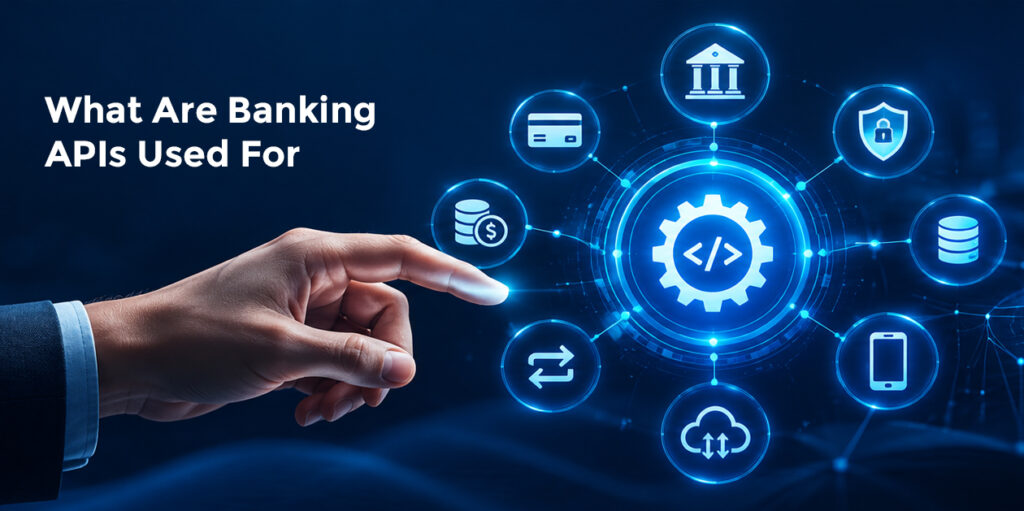
Banking apis can support many different financial functions.
Account management
APIs can allow authorized applications to create, manage, and retrieve information about financial accounts.
Payments
Businesses can integrate payment initiation and payment-status functionality into their own applications.
Transaction data
Authorized applications can retrieve transaction information for reporting, financial management, reconciliation, and other use cases.
Financial operations
APIs can connect applications with ledgers, payment processors, compliance systems, and other operational infrastructure.
Embedded finance
Businesses can incorporate financial services into non-financial software products, creating experiences where banking and payments are part of the customer’s existing workflow.
The major advantage is programmability. Instead of requiring customers or employees to manually move between multiple systems, financial functionality can be integrated directly into a digital product.
What Is an API Banking Platform?
An api banking platform provides the technology layer through which businesses can connect their applications to banking and financial services.
For fintechs, this can be significantly more efficient than developing every component of a financial stack internally.
A platform may provide connectivity for accounts, payments, transaction processing, ledgering, reporting, compliance, and other financial functions. The business can then build its own customer-facing application while using the underlying infrastructure through APIs.
This model is particularly relevant to Banking as a Service and embedded finance.
However, businesses should look beyond the API itself. An attractive developer experience does not automatically mean that the underlying financial infrastructure is appropriate for a particular business.
Fintech teams should evaluate the banking relationships, compliance model, supported markets, account structures, payment capabilities, operational controls, reconciliation processes, and scalability behind the API.
PRETpayments, for example, describes its infrastructure as connecting approved fintechs, MSBs, wallet platforms, stablecoin companies, and other financial businesses with sponsor-bank, payment, compliance, liquidity, and settlement infrastructure through an orchestration layer.
Learn more about PRETpayments’ banking infrastructure when evaluating infrastructure for a fintech or financial program.
What Is a Core Banking API?
A core banking api provides an interface through which authorized applications can interact with core banking functionality.
Core banking systems typically support fundamental banking operations such as account records, balances, transactions, and other financial functions.
Connecting applications to this infrastructure through APIs can separate the customer experience from the underlying banking technology.
For instance, a fintech can build its own mobile or web application while relying on connected financial infrastructure to manage accounts and transactions.
This separation can make product development more flexible. Developers can focus on customer-facing features without necessarily rebuilding the entire underlying banking system.
The API, however, is only one component. Reliability, security, regulatory requirements, operational controls, and the underlying banking relationship remain critical.
What Is Banking Open API Technology?
A banking open api enables authorized third-party applications to interact with financial information or services through standardized interfaces.
Open banking is one of the most visible applications of this concept.
Importantly, “open” does not mean that financial information is freely available to anyone. Access is controlled through authentication, authorization, customer consent, security mechanisms, and applicable regulatory requirements.
Open Banking standards, for example, include APIs for account information and payment initiation. Current specifications describe RESTful interfaces through which third-party providers can access information or initiate payments securely with customer consent.
What Are Open Banking Standards?
Open banking standards establish technical and security requirements that help financial institutions and third-party providers communicate consistently.
Standardization is important because financial ecosystems can involve many different institutions and technology providers. If every institution used a completely different interface, integrations would become expensive and difficult to maintain.
The Open Banking API specifications include areas such as Read/Write APIs, Open Data APIs, directory services, dynamic client registration, and reporting specifications.
Security is another important consideration. Open Banking’s security framework incorporates Financial-grade API approaches designed for financial services and highly secured OAuth-based authentication.
For fintechs, standards can make integrations more predictable while supporting stronger security and customer-consent mechanisms.
How Do Open Banking APIs Support Payments?
open banking api payments allow customers or businesses to initiate payments through authorized third-party applications while connecting to their bank or account provider.
A simplified journey can involve:
- A customer selects an account-to-account payment option.
- The application creates a payment request.
- The customer authenticates with the relevant financial institution.
- The institution authorizes the payment.
- The payment is processed.
- The application receives an update regarding the payment status.
Open Banking specifications explicitly include payment-initiation functionality alongside account-information services.
This approach can be useful for merchants, fintechs, marketplaces, and other businesses looking to incorporate account-to-account payments into digital customer journeys.
What Is an Online Banking API?
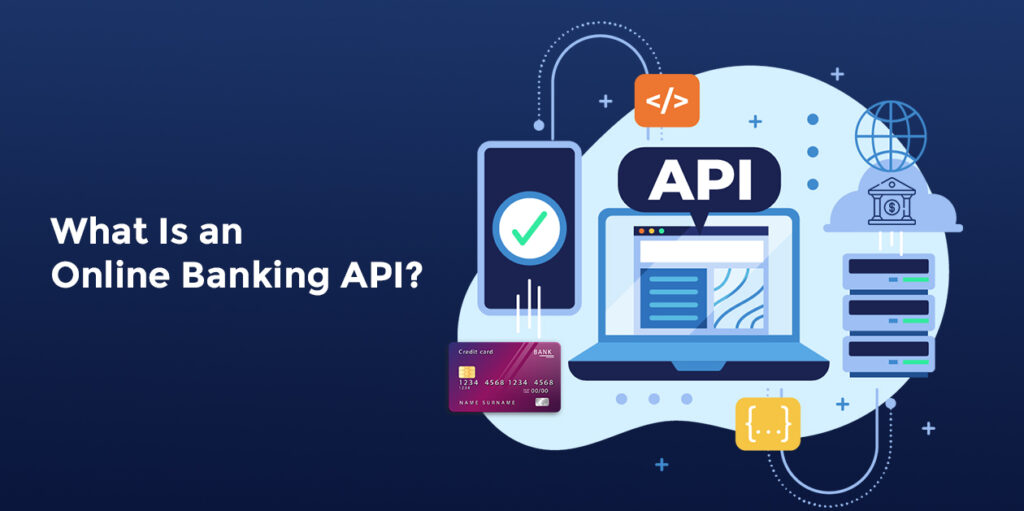
An online banking api provides programmatic access to selected banking functionality from an application.
For example, a financial management application could use an API to retrieve authorized account information and present it within its own interface.
Similarly, a business platform could use APIs to connect payment capabilities to an existing workflow.
This creates a more integrated customer experience because users do not necessarily need to leave the application they are already using to access a financial service.
Open Banking API Definition: What Does It Mean?
The open banking api definition can be understood as a standardized interface that enables authorized third-party applications to securely interact with banking information or payment services.
The key concepts are authorization, consent, security, and controlled access.
An open banking interface does not simply expose customer information. Instead, it creates a structured mechanism for customers to authorize access to their financial data or payment capabilities.
This distinction is important for fintech businesses because financial data is highly sensitive. API architecture must therefore be designed around appropriate authentication, permissions, security, and regulatory requirements.
Open Banking API Examples
Some practical open banking api examples include:
- A budgeting application retrieving authorized transaction data.
- A lending platform accessing financial information with customer permission.
- A merchant offering account-to-account payments.
- A financial management application aggregating accounts from multiple institutions.
- A business platform initiating payments from a customer’s bank account.
These examples show how APIs can connect traditional financial infrastructure with modern digital products.
Why APIs Matter to Fintech Companies
For fintech companies, APIs can reduce the amount of infrastructure that needs to be built internally.
Instead of developing an entire financial stack, a company may connect its application to established infrastructure and focus its engineering resources on its customer experience and differentiated product.
The potential benefits include:
Faster product development
Developers can integrate existing financial capabilities instead of building every function from scratch.
Greater flexibility
Modular integrations allow companies to add or change financial capabilities as their products evolve.
Automation
Payment initiation, transaction updates, account operations, and reporting can be integrated into automated workflows.
Scalability
Well-designed API infrastructure can support growing customer and transaction volumes when backed by appropriate underlying systems.
Better user experiences
Financial functionality can be embedded directly into an application’s existing customer journey.
For businesses operating internationally, API connectivity can be particularly valuable because different financial institutions, payment rails, and markets may require different integrations.
PRETpayments’ current platform positioning is focused on helping approved financial businesses access U.S. banking infrastructure, account issuance, payment capabilities, settlement, compliance workflows, and related services through an integrated operating layer.
Businesses can explore PRETpayments’ capabilities to understand how its infrastructure is positioned for fintechs, MSBs, wallet platforms, stablecoin businesses, and cross-border financial programs.
How to Build a Banking API Strategy
A strong banking api strategy should start with business and regulatory requirements rather than simply choosing the API with the most endpoints.
1. Identify the required financial services
Determine whether the product needs accounts, payments, transaction data, ledgering, settlement, treasury, wallets, or other capabilities.
2. Understand the target markets
Banking relationships, payment rails, licensing requirements, and compliance obligations can differ between countries and regions.
Understand which activities are handled by the bank, infrastructure provider, fintech, payment partner, or other program participants.
Review authentication, authorization, encryption, monitoring, logging, access management, rate limiting, and incident-response processes.
Look beyond API uptime. Assess redundancy, operational resilience, reconciliation, transaction-status management, support, and failure handling.
6. Review developer experience
Good documentation, sandbox environments, testing tools, webhooks, version management, and technical support can materially affect implementation.
The infrastructure should be capable of supporting future customer growth, higher transaction volumes, additional payment corridors, and new financial products.
API Banking and PRETpayments
For a fintech, the API should be viewed as part of a larger financial infrastructure strategy.
A developer may care about endpoints, authentication, documentation, and response times. A business leader must also consider banking access, compliance, sponsorship, settlement, transaction visibility, operational controls, and scalability.
This broader perspective is particularly relevant to PRETpayments.
PRETpayments states that it works with approved programs and connects them with sponsor-bank and fintech partners. Its current infrastructure offering includes named account issuance, funds movement, ledgering, reporting, compliance workflows, payment capabilities, settlement, treasury, wallets, and stablecoin-related infrastructure.
Its stated focus on bank visibility is also significant. PRET explains that its infrastructure is designed to help banks maintain visibility into customers, programs, transaction activity, compliance records, and reporting frameworks.
This illustrates an important E-E-A-T consideration when evaluating financial infrastructure: the technology should not be assessed in isolation from the banking, compliance, and operational framework surrounding it.
You can also explore PRETpayments’ global payment gateway for information about its global payment infrastructure. The company states that its unified API can integrate with backend systems and supports payment options including SWIFT, stablecoins, cards, RTP, Visa Direct, and ledger payments.
What Makes a Banking API Secure?
Security should be considered throughout the entire API lifecycle.
Important controls can include:
- Strong authentication
- Authorization and permission management
- Encryption
- Secure credential management
- Rate limiting
- API monitoring
- Logging and audit trails
- Fraud detection
- Vulnerability management
- Incident-response procedures
- Secure software-development practices
NIST’s updated guidance highlights the importance of identifying API vulnerabilities across different lifecycle stages and implementing appropriate protection measures.
For financial businesses, API security also needs to operate within the broader compliance and risk-management framework of the financial product.
The Future of APIs in Banking
APIs are becoming increasingly important as financial services become more interconnected.
Open banking has demonstrated how standardized interfaces can enable account information and payment services to connect with third-party applications. Meanwhile, embedded finance is expanding the use of programmable financial infrastructure beyond traditional banking applications.
For fintechs, the opportunity is to combine APIs with reliable banking relationships, payment infrastructure, compliance controls, and operational systems.
The future of financial technology is therefore unlikely to be about APIs alone. It will be about building dependable infrastructure around those APIs.
Businesses that select infrastructure based only on developer convenience may overlook critical considerations such as regulatory responsibilities, settlement, bank visibility, transaction controls, and operational resilience.
The strongest approach is to evaluate the complete financial infrastructure supporting the API.
Final Thoughts
An API is more than a technical connection between two software applications. In modern financial services, it can become the bridge between a fintech’s customer experience and the banking, payment, account, compliance, and settlement infrastructure operating behind it.
For fintech founders and product teams, the right API architecture can make financial products easier to build, integrate, automate, and scale.
But choosing an API provider requires looking beyond documentation and endpoints. Businesses should evaluate security, infrastructure reliability, regulatory responsibilities, banking relationships, operational controls, scalability, and the financial capabilities available through the integration.
For approved financial businesses looking for a broader infrastructure approach, PRETpayments provides a platform focused on connecting fintechs and other financial programs with banking, payments, account infrastructure, sponsorship, compliance, and settlement capabilities.
The key takeaway is simple: the best banking API is not necessarily the one with the most features. It is the one that fits the business, regulatory model, financial infrastructure, and long-term growth strategy behind the product.
Ready to Build Smarter Financial Products?
The right API infrastructure can help fintechs connect banking, payments, accounts, and financial workflows without building every component from scratch. PRETpayments provides infrastructure designed to help approved fintechs, MSBs, wallet platforms, stablecoin companies, and other financial businesses access banking, payment, settlement, and compliance capabilities.
Ready to explore what’s possible? Get started with PRETpayments and discover infrastructure built to help your financial business launch, operate, and scale.